
Our Blog

Are dental X-rays safe?

December 10th, 2013
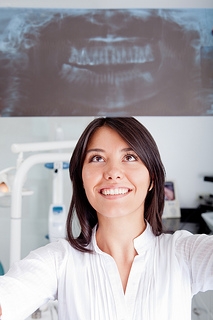
YES! X-rays have been used in dentistry for a long time, and the amount of radiation has significantly decreased with advances in technology. While there is risk in every health diagnostic procedure at Pioneer Dental, the benefits must outweigh the risks. Dental X-rays do indeed fall into this category.

X-rays are exposed to a type of film to produce an image. The amount of X-rays required to produce this image differs with film speeds. Speed E or F is highly recommended, and digital X-rays require up to 50% less than speed E or F film. The digital X-ray software can adjust the exposure to produce a quality image. Digital X-rays are becoming a new standard and are most common.

Lead aprons have been used to reduce the amount of scatter radiation. All X-ray units have a cone to focus the X-ray beam so the exposure is highly localized. Lead aprons continue to be worn as a precaution for pregnant women, and a thyroid collar should also be worn. In most cases, this is sewn into the lead apron.

We get radiation exposure from environmental factors as well as healthcare diagnostic and treatment tools. To place this in perspective, in one year a person is expected to have 360mRem per year from the sun, air etc. By comparison, a single set of bitewing X-rays is 0.3mRem. Radiation can accumulate in our body over a lifetime, and additional exposure should be avoided whenever possible.

What are dental implants?

December 3rd, 2013

Do you have a space where a tooth used to be? Were you born with a missing tooth? Are you getting ready for dentures? You may be a good candidate for a dental implant. Metal dental implants were invented in 1965. Technology continues to advance with millions of implants placed in the United States and Canada. Placing implants has become mainstream and a common practice for offices like ours.

A dental implant is a small titanium post, which resembles a screw with threads. The post also has holes for bone to integrate. A dental implant is placed into the jawbone during a short dental procedure. It is relatively painless with very little post-operative pain. The threads on the implant post allow for the bone to fill in and integrate. To facilitate this process the implant is re-covered with gum tissue and allowed to heal and integrate for nearly three months. The implant acts as the root for the tooth to provide solid and stable support for the crown that’s yet to be placed.

The next step in the dental procedure is to uncover the implant and place a healing cap to allow the gum tissue to heal. After a short period of healing, an impression is taken to fabricate a crown to fully restore the missing tooth. The crown is then cemented on top of the post, at which point you can resume normal eating activities.

Dental implants do require some special care, but that is easily managed when you follow the directions outlined by Dr. Carl Meyers. During your regularly scheduled cleaning, special instruments are used to clean implants. While a dental implant cannot get a cavity, a condition known as peri-implantitis can occur. This is very similar to periodontal disease as the end result is dental implant loss and loss of bone structure. Be sure to floss the dental implant daily and run the floss under the implant crown as far as it can go to remove food and plaque. If you use any picks or small brushes to go in between your teeth, make sure they are plastic. Metal will scratch the implant making it more susceptible to infection. Be sure to keep your regular dental visits and cleanings to monitor the implant and help preserve your investment.

Thanksgiving in North America

November 26th, 2013

Thanksgiving marks the start to the holidays; a season filled with feasting, indulging, and spending time with family and friends are always special. Thanksgiving is a holiday meant for giving thanks, and while this may seem like such a natural celebration, the United States is only one of a handful of countries to officially celebrate with a holiday.

Unlike many holidays, Thanksgiving is a secular holiday, and it is celebrated on the fourth Thursday in November in the United States. In Canada, it is celebrated on the second Monday of October, which is, oddly enough, much closer to a time when harvests were likely gathered. In addition to the different dates, the origins of the celebration also share different roots.

Thanksgiving in the United States

Giving thanks for a bountiful harvest are not new, but the modern day holiday in the US can be traced to a celebration at Plymouth in Massachusetts in 1621. This feast of thanksgiving was inspired by a good harvest, and the tradition was simply continued on. At first, the colony at Plymouth didn't have enough food to feed everyone present, but the Native Americans helped by providing seeds and teaching them how to fish, and they soon began to be able to hold a feast worthy of the name. The tradition spread, and by the 1660s, most of New England was hosting a Thanksgiving feast in honor of the harvest.

Canadian Thanksgiving

An explorer of early Canada named Martin Frobisher is accredited for the first Canadian Thanksgiving. He survived the arduous journey from England through harsh weather conditions and rough terrain, and after his last voyage from Europe to present-day Nunavut, he held a formal ceremony to give thanks for his survival and good fortune. As time passed and more settlers arrived, a feast was added to what quickly became a yearly tradition. Another explorer, Samuel de Champlain, is linked to the first actual Thanksgiving celebration in honor of a successful harvest; settlers who arrived with him in New France celebrated the harvest with a bountiful feast.

A Modern Thanksgiving

Today, Thanksgiving is traditionally celebrated with the best of Americana. From feasts and football games to getting ready for the start of the Christmas shopping season, Thanksgiving means roasted turkey, pumpkin pie, and green bean casserole. No matter how you celebrate this momentous day, pause for a moment to give thanks for your friends, family, and all the bounties you’ve received. Happy Thanksgiving from Pioneer Dental!

The Advantage of Philips Zoom Whitening

November 19th, 2013

Today, we thought we’d talk a little about Philips Zoom whitening at Pioneer Dental. Philips Zoom, a professional teeth whitening treatment, gets your teeth an average of eight shades whiter in just one hour at our convenient West Bend, WI office. It is a great way to enhance the appearance of your smile.

With Dr. Carl Meyers, Philips Zoom is safe, simple, and relaxing! Not only that, but Philips Zoom is championed by dentists and patients from coast-to-coast as a pain-free process.

After three 15-minute applications within one hour, your treatment is complete, leaving you with a brighter, whiter smile. It’s that easy!

Please give us a call to schedule an appointment for Philips Zoom whitening.

docsAmerican Dental AssociationInvisalign

Services